Turn renewable operations into measurable, predictable performance. Forecasting, diagnostics, and asset intelligence built for real-world SCADA, grid constraints, and O&M execution.
AI that improves yield, uptime, and decision speed
Renewable assets generate huge signal volumes SCADA, inverter logs, weather feeds, meters, and maintenance histories but most teams can’t turn that into fast operational decisions. MetRenew applies AI where it creates measurable outcomes: better forecasting with uncertainty ranges, earlier fault detection, and maintenance prioritization that reduces downtime and truck rolls. We focus on practical integration clean data pipelines, traceable model performance, and deployment that fits control-room routines so AI becomes part of daily operations, not a disconnected pilot.
Our Solutions
Probabilistic Forecasting & Uncertainty Bands
High-resolution solar and wind forecasting with confidence intervals to improve scheduling, dispatch planning, and reserve decisions. We translate forecasts into actions: operating thresholds, alerting rules, and performance tracking so teams reduce imbalance exposure and plan maintenance around expected generation windows.
Performance Diagnostics & Loss Attribution
Identify underperformance drivers using SCADA, metering, and environmental signals soiling, clipping, curtailment, wake effects, sensor drift, or availability losses. We deliver diagnostics that connect “what changed” to “what to do next,” enabling faster root-cause analysis and defensible performance reporting.
Anomaly Detection & Early Fault Discovery
Detect abnormal behavior across inverters, strings, turbines, substations, and BESS interfaces before faults cascade. We build anomaly models that are explainable and actionable prioritizing alerts, reducing false positives, and linking findings to inspection plans, spare strategy, and warranty evidence.
Predictive Maintenance & Reliability Analytics
Shift from reactive to condition-based maintenance by predicting failure risk and remaining useful life for critical components. We help teams reduce unplanned downtime, improve availability, and optimize maintenance spend integrating insights into CMMS workflows and reliability routines.
MLOps, Data Governance & Secure Deployment
Build the foundation to run AI at scale: data quality rules, lineage, model monitoring, drift detection, and audit trails. Deploy models in cloud/edge setups that fit OT realities so performance is trackable, security is designed in, and scaling across sites is controlled.
Use Cases & Outcomes
Day-Ahead Dispatch for Utility-Scale Solar/Wind
Forecasts tied to operating decisions and uncertainty ranges. Outcome: better scheduling, fewer imbalance penalties, and clearer control-room triggers for curtailment, reserves, and maintenance windows.
Underperformance Triage Across Portfolios
Automated loss attribution and anomaly ranking across many sites. Outcome: faster root-cause identification, fewer blind truck rolls, and a prioritized worklist that lifts yield and availability.
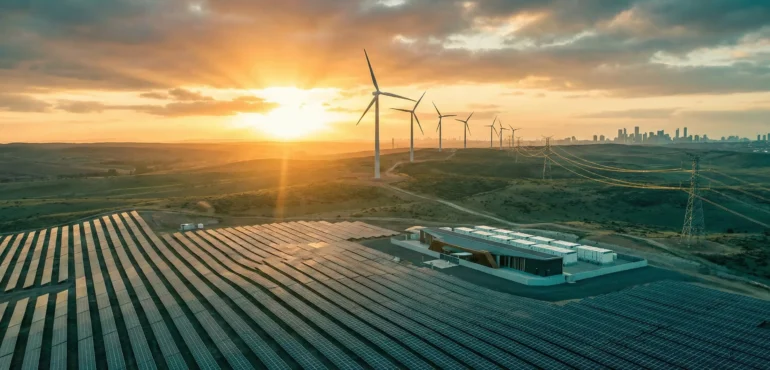
Hybrid Plant Optimization (Solar + BESS)
Forecast-informed charge/discharge logic and performance diagnostics across interfaces. Outcome: improved dispatch credibility, cleaner acceptance of operating behavior, and fewer integration surprises at the plant controller layer.
Warranty-Ready Fault Evidence
Detect faults early and package evidence from SCADA + diagnostics. Outcome: stronger warranty/claims support, clearer RCA documentation, and reduced repeat failures through targeted corrective actions.
Why Metrenew
Energy-first digital execution
We start with plant realities yield, availability, grid constraints then design the AI layer around measurable operational outcomes.
Security by design (OT + IT)
AI value collapses without trust. We embed access controls, monitoring, and governance so models can run safely inside energy operations environments.
Pilot-to-scale delivery discipline
Baseline KPIs → pilot → validate ROI → scale with governance. No “innovation theatre.”
Build AI that your operations team will actually use
Forecasting, performance diagnostics, anomaly detection, and predictive maintenance applied to real operational data (SCADA, meters, weather, CMMS) to improve yield, uptime, and decision speed.
Do you build models or integrate existing tools?
We prioritize integration. If you already have historians, SCADA, CMMS, or analytics tools, we connect the pipeline and operationalize outputs. If gaps exist, we define a minimal architecture that can scale.
What data sources are typically required?
SCADA/inverter or turbine telemetry, meters, weather feeds, alarms/events, asset registers, maintenance logs, and (when relevant) market/grid signals enough to link performance signals to operational actions.
How do you prevent “black box” outputs?
We design explainability into the workflow: loss attribution, traceable feature drivers, and validation metrics. Outputs must be interpretable by engineering and O&M teams, not only data scientists.
Can you support solar, wind, and hybrid plants?
Yes. Models and workflows are tuned to the asset type and controls stack, including hybrid interfaces where plant control and storage behavior must be coherent.
How do you measure ROI?
We baseline KPIs (availability, yield, response time, truck rolls, downtime) before deployment, then track uplift through controlled pilots and monitored rollouts.
How do you handle cybersecurity and OT constraints?
We design for OT realities segmentation, access control, monitoring, and secure integration so AI can run without increasing operational risk.
How fast can a pilot be delivered?
A pilot timeline depends on data readiness and access approvals. We start with a data + KPI baseline, then deliver a narrow, measurable use case before scaling.
Let’s Connect
Talk to Our Team
Whether you’re evaluating a new project, strengthening feasibility, preparing for EPC execution, or building ESG readiness, we’ll help you clarify the next steps and structure the path forward with measurable delivery milestones.